
Football is one of the most popular sports worldwide, played in schools, clubs, and professional leagues. For beginners, understanding the basics of the game, rules, and techniques is the first step toward enjoying and improving at football.
A thrilling sport that blends athleticism, teamwork, and strategic thinking is football, also known as football in many parts of the world. Millions of people love this sport, which is played on fields and in public spaces worldwide, making it one of the easiest games to master. Starting with a solid foundation is essential to both enjoying the game and developing your skills if you want to put on your boots and join the battle.
What is Football? Understanding the Basics
The Objective
Football is a team sport where two sides compete to score goals by getting the ball into the opponent’s net.
Team Setup
Each team typically has 11 players: a goalkeeper, defenders, midfielders, and forwards. It can be thrilling and a little intimidating to enter the world of football for the first time. The good news is that learning football is a very fulfilling experience. To begin, all you need is a passion for the game and a willingness to learn—you don’t even need to be a professional athlete.
The secret is to concentrate on learning the fundamentals, developing a few key abilities, and obtaining a sense of how the game is played on the pitch. Building a strong foundation will help you enjoy every time on the pitch and increase your confidence as a player, whether your goal is to join a local team or just kick a ball around with friends.
Football Rules for Beginners
The goal of Football Rules for Beginners is to simplify the game for novices. Football is fundamentally about two teams fighting to score points, whether through touchdowns in American football or goals in association football (soccer). The regulations give the game structure, guaranteeing fair play and directing everything from kickoffs and scoring to fouls and penalties. Gaining an understanding of these fundamentals enables novices to confidently watch games and thoroughly appreciate the sport.
Match Duration
A standard match lasts 90 minutes, split into two halves of 45 minutes each.
Basic Rules
- No handling the ball (except the goalkeeper).
- The offside rule prevents unfair positioning.
- Fouls result in free kicks or penalties.
Essential rules and gameplay mechanics should be the main focus for novices. This entails knowing how games begin, how points are counted, what constitutes a foul, and how referees uphold fairness. New players and supporters can swiftly transition from uncertainty to clarity by understanding these principles, turning football from a game they watch to one they actively participate in. To put it briefly, football regulations provide the framework for strategy, skill development, and enjoyment of the game.
Types of Football Explained
Beginners can better grasp the many forms of football played around the world by reading Types of Football Explained. In most countries, “football” refers to association football (soccer), while in the United States, it refers to American football, a game centred on touchdowns, tackles, and calculated plays. Football is a varied and international sport since each variety has its own set of rules, gear, and playing style.
Association Football (Soccer)
The global version played under FIFA rules.
American Football
A different sport popular in the USA, involving touchdowns and passes.
Flag Football
A non-contact version of American football. The most popular game in the world, association football (soccer), American football, flag football, rugby football, and even fantasy football all provide players and viewers with different experiences.
Whether they enjoy the fast-paced dribbling of soccer, the tactical depth of American football, or the recreational fun of flag football, understanding the differences between these formats helps novices select the format that best fits their interests. To put it briefly, there are numerous varieties of football, each with its own rules, culture, and appeal.
How to Play Football for Beginners?
Starting Out
Learn positions, basic passing, and teamwork.
Key Focus
Stay active, understand spacing, and practice simple ball control.
Knowing the Fundamentals of Football for Newbies
On a rectangular pitch with goalposts at either end, two teams of eleven players each play football. The idea is straightforward: kick towards the opposing team’s goals to score more points than they do. At the end of the game, the team with the most goals wins.
Essential Tools You will need the following basic equipment for the first time:
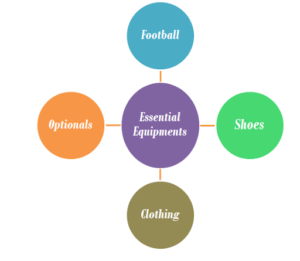
- Football: A spherical ball composed of synthetic or leather.
- Shoes: Cleats or football shoes with moulded soles or studs to provide you with traction on grass or turf.
- Clothes: Wearing cosy sportswear, such as shin guards to protect your legs and jersey shorts, and socks.
- Optional Equipment: A water bottle to stay hydrated and keeper gloves, if you’re playing as the goalie.
Essential Football Skills for Beginners
- Passing – Moving the ball accurately.
- Dribbling – Controlling the ball while running.
- Shooting – Striking the ball toward goal.
- Defending – Blocking opponents and regaining possession.
Football Techniques for Beginners
Ball Control
Use the inside of your foot for better accuracy.
Tackling
Learn safe tackling to avoid fouls.
Heading
Direct the ball using your forehead.
Football Fundamentals: The Basis of the Game
Knowing the fundamentals of football is essential before you ever set foot on the pitch. The object of the game is to score more goals than your opponent by getting the ball into their net. There are two teams of eleven players each. The main regulation to bear in mind is that no player may touch the ball with their hands or arms outside of their assigned penalty area, with the exception of the custodian. There is a 15-minute halftime break between each of the game’s two 45-minute halves. A football, a shirt, shorts, socks, and—above all—shin guards and football boots are essential pieces of gear for both performance and safety.
Another essential component of understanding the game is comprehending the dimensions of the pitch, the various lines (touchlines, goal lines), and the goal itself.
Football Drills for Beginners to Improve Faster
- Cone Drills: Improve dribbling.
- Passing Circles: Enhance accuracy.
- Small-Sided Games: Practice teamwork.
Football Dribbling Drills for Beginners
- Cone Zig-Zag: Dribble through cones.
- 1v1 Practice: Learn to beat defenders.
- Speed Dribble: Sprint while controlling the ball.
Football Training for Beginners – Weekly Practice Plan
Recognising the Guidelines
Football is governed by its own set of rules. For novices, the following rules are essential:
- Offside Standards: When a player is awarded the ball, they are deemed to be offside if they are closer to their opponent’s goals than to the ball and the second-place finisher.
- Penalties and Fouls: The opposing side may be awarded penalties or free kicks for improper behaviour, such as pushing, tripping, or using the hands to handle the ball (apart from goalkeepers within their penalty area).
- Throw-ins, corner kicks, and goal kicks: These are the ways that play can resume when the ball leaves the playing area or is hit by an opponent.
Example Plan
- Day 1: Passing & ball control.
- Day 2: Shooting practice.
- Day 3: Dribbling drills.
- Day 4: Fitness & stamina.
- Day 5: Small-sided match.
Mastering Essential Skills
Beyond the very first steps, mastering a few key skills can dramatically improve your game.
Dribbling is more than just running with the ball; it’s about control. Practice running with the ball at different speeds, keeping it just a few inches from your feet, and using both your left and right feet to maneuver it.
Passing is the cornerstone of teamwork. You should learn to pass to a teammate’s feet, or into a space where they can run onto it. This is best practiced with a partner or against a wall.
Shooting requires striking the ball with the laces of your boot for power, or the inside of your foot for accuracy. Practicing from different distances and angles will help you become a goal-scoring threat.
Understanding Key Positions
A fundamental aspect of playing football is understanding the different positions and roles on the pitch. A team is typically divided into four main areas:
- the Goalkeeper,
- the Defenders,
- the Midfielders,
- the Forwards (or strikers).
The Goalkeeper is the last line of defense and the only player who can use their hands inside the penalty box. Defenders protect the goal, blocking shots and tackling opposing attackers. Midfielders are the workhorses of the team, linking the defense and attack and often covering the most ground on the pitch as part of football tricks for beginners. Finally, Forwards are positioned closer to the opponent’s goal, with their primary job being to score goals. As a beginner, it’s a great idea to try out a few different positions to see where you feel most comfortable regarding football knowledge for beginners.
Easy Football Tricks for Beginners to Learn Quickly
- Step Over: Fake a move to trick defenders.
- Drag Back: Pull the ball back to change direction.
- Body Feint: Use body movement to mislead opponents.
Football Routes for Beginners
Offensive Runs
- Straight run toward goal.
- Diagonal run to create space.
Defensive Routes
- Track back to cover opponents.
How to Kick a Football for Beginners
- Instep Kick: For power.
- Inside Foot Kick: For accuracy.
- Laces Kick: For long passes.
How to Throw a Football for Beginners
(For American football beginners)
- Grip the ball with fingers on laces.
- Step forward and release with a spiral motion.
Flag Football for Beginners – Rules & Basic Drills
For those who are new to this fast-paced, non-contact variation of American football, Flag Football for Beginners: Rules & Basic Drills is the ideal place to start. Flag football is safer and more accessible for players of all ages than tackle football because it places more of an emphasis on agility, teamwork, and strategy. The regulations are straightforward: defenders pull a flag fastened to the ball carrier’s waist to halt play rather than tackle, fostering an enjoyable and welcoming atmosphere for learning the game.
- No tackling, only flag pulling.
- Smaller teams (5–7 players).
- Focus on passing, catching, and running routes.
Fantasy Football for Beginners – Rules & How It Works
Fantasy football lets fans create virtual teams using real players. Points are scored based on players’ real-life performances.
How to Draft Fantasy Football for Beginners
- Research player stats.
- Balance positions (QB, RB, WR, etc.).
- Avoid overloading on one team’s players.
Fantasy Football Tips & Advice for Beginners
- Track injuries and form.
- Use waiver wire for replacements.
- Play matchups strategically.
Beyond the fundamentals, organised drills that develop fundamental abilities like passing, catching, route running, and defensive positioning are beneficial for novices.
These exercises teach the principles of cooperation and communication in addition to enhancing individual performance.
To put it briefly, flag football is a great starting place for new players who are eager to learn and participate since it provides a fun and safe method to experience the spirit of the game.
How to Bet on Football for Beginners
The goal of How to Bet on Football for Beginners is to make joining one of the most well-known betting markets in the world easier.
With jargon like odds, spreads, and handicaps, Football betting may initially seem complicated, but the fundamentals are simple: you wager on player performances, goals, or match outcomes, and you win if your prediction comes true. Beginners can avoid typical blunders and gain confidence by grasping the fundamentals.
- Types of Bets: Match winner, goals scored, handicaps.
- Responsible Betting: Set limits and avoid chasing losses.
Common Mistakes Beginners Should Avoid
- Ignoring fitness.
- Over-dribbling instead of passing.
- Neglecting teamwork.
Understanding the various kinds of bets and how odds operate is a crucial first step. Football offers a variety of markets, from straightforward match outcome wagers (win, lose, draw) to more complex choices like over/under goals or both teams to score (BTTS).
Additionally, novices should concentrate on managing their bankroll, which includes creating a budget, refraining from chasing losses, and viewing gambling as entertainment. To put it briefly, learning the fundamentals, exercising self-control, and progressively investigating more sophisticated tactics as one’s understanding expands are the key components of football betting for novices.
Tips to Improve Football Skills Faster
Advice for Developing Football Skills: quicker emphasis on discipline, organised practice, and clever training techniques that speed up development.
Drills that improve fundamental skills like passing, dribbling, shooting, and placement are beneficial for both novice and expert players.
Players can improve their performance during games by developing muscle memory and confidence through the combination of focused training and regular repetition.
- Practice regularly.
- Watch professional matches.
- Train both feet.
- Focus on stamina and agility.
The quickest improvement occurs when technique, fitness, and game awareness are balanced. Players can quickly adjust to actual match scenarios by incorporating tactical lessons, small-sided games, and agility training.
Steady improvement is ensured by keeping track of progress, establishing realistic goals, and practicing frequently. To put it briefly, developing football skills more quickly requires discipline, organised training, and the application of acquired skills in real-world situations—turning practice into performance.
Football Beginner FAQs
Q1: How long is a football match?
90 minutes plus stoppage time.
Q2: What equipment do I need?
Football boots, shin guards, and a ball.
Q3: How many players are on a team?
11 players per side in standard football.
Q4: Can beginners join clubs?
Yes, most local clubs welcome beginners.
Disclaimer – At 96.com, users can enjoy 96bet casino and the best crypto football sportsbook experience on one of 96 football. Play smart and make sure gaming stays fun and under control.